
Types of AR-15 Upper Receivers
If you are a rifle enthusiast, you know exactly how important upper receivers are to the build of your AR. The variety of options you have for your rifle is impressively wide. The choice can depend on many factors, including the purpose of the model and your budget.
In this AR-15 receiver guide, experts from JSE Surplus share important information and explain how to make the best choice for your needs.
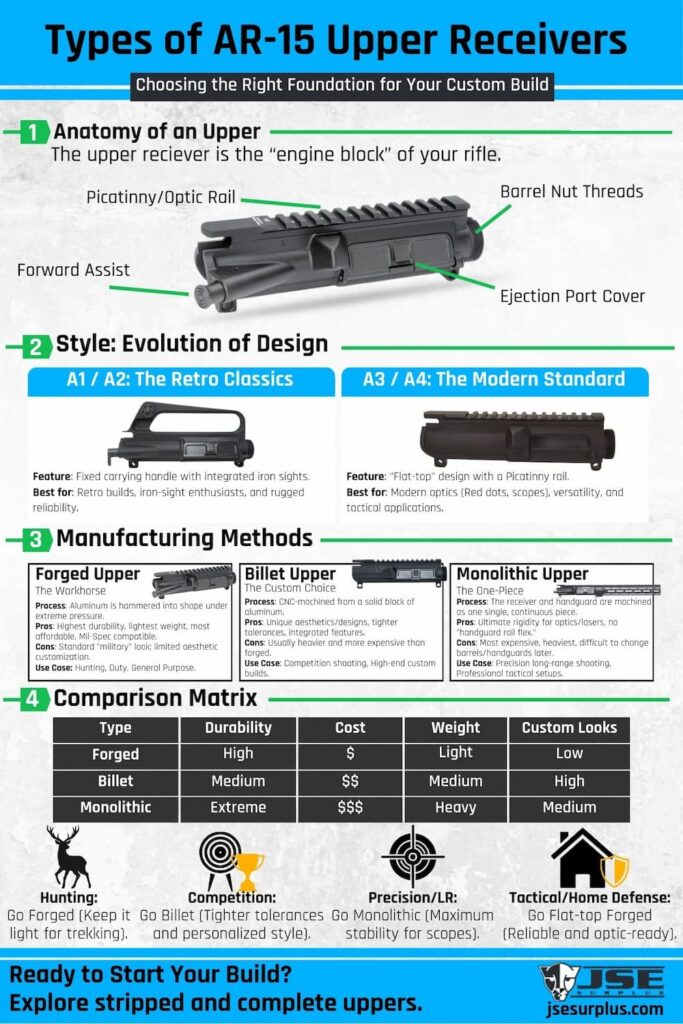
Forged Upper Receivers: The Industry Standard
Forged upper receivers are the most common type on AR-15 rifles today. Their excellent performance and quality make these uppers the default choice for many manufacturers. If you are looking for a reliable and cost-effective option, this is the best place to start.
These receivers are made by compressing heated aluminum into a mold using powerful hammers. This process aligns the metal’s grain structure to create a stronger product. After forging, the receiver is machined to precise dimensions.
The main benefits of this option are:
- Strength-to-Weight Ratio: These receivers are lightweight yet strong enough for heavy use.
- Affordability: They are well-priced and easy to find on the market
- Compatibility: The majority of forged uppers follow MIL-SPEC dimensions, which makes them compatible with many AR-15 components.
Forged upper receivers are ideal for duty rifles. They work great for anyone who is on a tight budget but still wants quality rifle components.
Billet Upper Receivers: Precision and Style
Billet upper receivers are designed for shooters who prefer customization and care about visual appeal. While they serve the same function as forged uppers, billet receivers have unique designs.
These uppers are CNC-machined from a solid block of aluminum. This method allows manufacturers to shape the receiver with extreme precision. It also leaves room for imagination and allows adding design features that aren’t possible with forging.
The main benefits are:
- Aesthetics
- Tighter tolerances (for improved fit and performance)
The downsides include higher costs and potential compatibility issues because not all of them follow MIL-SPEC dimensions.
Billet AR-15 upper receivers work best for custom builds. If you like a premium look and feel, this is your choice. It also offers higher precision, so it’s great for competitions.
Monolithic and Specialized Uppers
Some AR-15 upper receivers are designed for specific performance goals rather than general use.
Monolithic Uppers
Monolithic uppers have a one-piece design. It means that the upper receiver and handguard are made as a single unit. This design increases rigidity and helps maintain optic zero, even under heavy use.
Slick Side vs. Standard
“Slick side” uppers remove the forward assist and possibly the brass deflector, resulting in a cleaner appearance and slight weight savings. Standard uppers retain the forward assist and shell deflector. They work for users who prefer traditional functionality.
Choosing the Right Upper for Your Build
Regardless of what upper you used to have on your AR-15, here are things to consider when planning the next purchase:
Budget vs. Performance
Forged upper receivers offer the best balance of cost and reliability. Billet uppers are more expensive, but they provide tighter tolerances and enhanced visual appeal.
Intended Use
A range rifle usually doesn’t require advanced features, while duty or defensive rifles benefit from proven designs. If you plan competition or precision shooting, billet and monolithic uppers may be the best choice.
Compatibility and Fit
Before making the final choice, confirm that the upper receiver matches your lower receiver profile and caliber. Not all uppers follow the same specifications, and mismatched components can affect reliability.
Find Your Next Upper at JSE Surplus
Do you have a good idea of what type of AR-15 upper receiver you need? Are you still choosing? Either way, browsing our wide selection of uppers can help.
At JSE Surplus, we are happy to give you as many options for your AR-15 rifle as possible. Our experts are always ready to help you make the right choice.
Image credit : Lutsenko_Oleksandr