
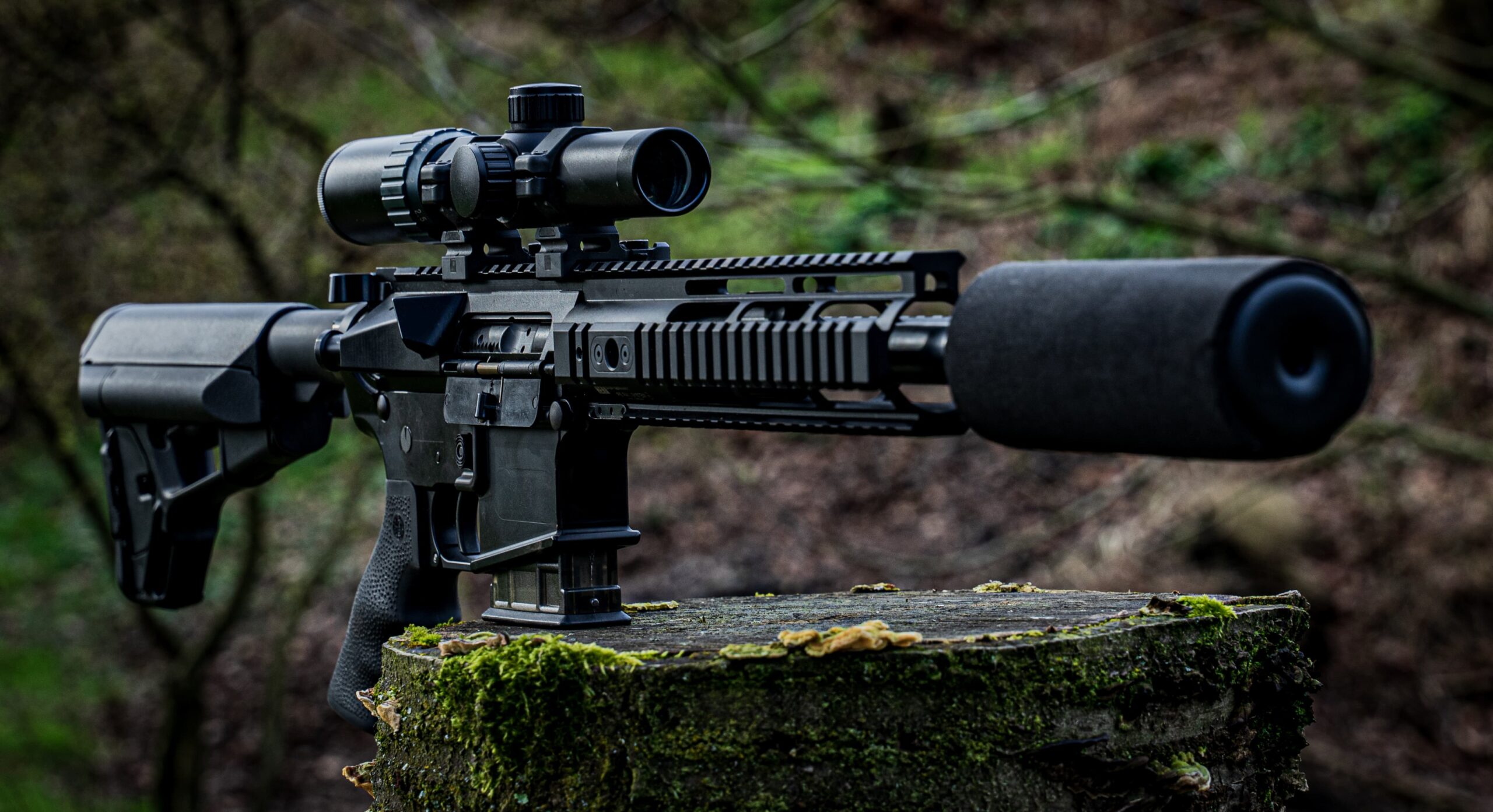
.300 Blackout vs 5.56 Subsonic: Ballistics, Cycling, and Suppressor Setup
Key Takeaways / Summary:
- The .300 Blackout delivers vastly superior terminal energy and dependable semi-automatic cycling in subsonic configurations.
- Subsonic 5.56 eliminates the supersonic crack but fails to generate enough gas pressure to reliably cycle standard AR-15 actions.
- With bullet weights spanning 200 to 220 grains, heavy .300 Blackout rounds are purpose-designed to deliver optimal quiet performance when suppressed.
Choosing the right cartridge for a suppressed build requires balancing sound reduction, terminal ballistics, and firearm mechanics. JSE Surplus has supplied builders nationwide since 2001, specializing in the AR platform.
Our team understands the nuances of tuning suppressed firearms. When evaluating .300 Blackout vs. 5.56 Subsonic loads, physics dictates how each round performs through a silencer.
5.56 vs .300 Blackout Ballistics: Velocity, Noise, and Sound Suppression
True sound suppression requires keeping bullet velocity below the speed of sound, roughly 1,125 feet per second. Supersonic rounds produce an audible sonic crack as they travel downrange, which a silencer cannot eliminate.
Standard 5.56 NATO fires light projectiles between 55 and 77 grains at speeds exceeding 2,800 feet per second. Slowing a 55-grain bullet down under 1,050 feet per second removes the crack, but it destroys downrange performance. A subsonic 55-grain projectile produces energy levels comparable to a standard .22 Long Rifle.
By comparison, .300 Blackout loads feature substantially heavier projectiles, typically ranging from 200 to 220 grains. Propelling this increased mass at 1,050 feet per second provides far greater kinetic energy and impact momentum while maintaining ultra-quiet subsonic operation.
The Difference Between Subsonic 5.56 and .300 Blackout Cycling in the AR-15
The primary difference between .300 Blackout and 5.56 Subsonic performance lies in gas drive. The AR-15 direct impingement system relies on bore pressure and gas volume to push the bolt carrier group rearward.
Subsonic 5.56 uses minimal powder charges to maintain low velocities behind a tiny bullet. Consequently, it creates insufficient port pressure, turning your semi-automatic rifle into a manual, single-shot action.
The .300 AAC Blackout cartridge was engineered from inception to solve this problem. Its larger bore volume and heavier bullet create the necessary dwell time and chamber pressure to cycle standard AR-15 bolts, carbine buffers, and standard magazine components cleanly.
Is .300 Blackout Bigger and Quieter Than 5.56 Subsonic?
Shooters often ask if the .300 Blackout is bigger than 5.56; and the answer is yes. The .300 Blackout uses a .308-inch diameter projectile seated in a shortened, necked-up 5.56 casing, compared to the .224-inch diameter of the 5.56.
When comparing standard supersonic rounds, both produce significant noise. However, when comparing dedicated subsonic loads through a quality silencer, .300 Blackout runs remarkably quiet while delivering the functional cycling that 5.56 simply cannot match.
Building Your Suppressed AR Host: Tuning Uppers, Barrels, and Gas Systems
Building a reliable suppressed host requires quality components. We provide complete AR-15 uppers, premium barrels, lower parts kits, and tactical gear to get your rifle running smoothly. Optimal subsonic setups benefit from pistol-length gas systems on shorter barrels, paired with an adjustable gas block to balance backpressure.
Explore our full inventory, or if you need assistance selecting the correct barrel twist or gas setup for your build, visit our team in Cape Girardeau, Missouri, or reach out directly.
Image Credit: RagnarRagnarson / Shutterstock